
Very Important Distinction: Autonomy, More Often Threatened Than Gaslight

In the quiet architecture of my personal and professional life, I have long insisted on the grace of autonomy—not as a privilege, but as a rite. Whether personal or corporate, autonomy is the threshold through which wellbeing enters. It is the dignity of choosing one's own rhythm, one's own perception, one's own presence.
And beyond its ceremonial weight, autonomy carries neurological consequence. It is the condition under which the nervous system finds safety, coherence, and rest.
When autonomy is honored, the brain does not brace—it breathes. When autonomy is trespassed, the body does not trust—it tightens.
Yet in recent discourse, I have witnessed a troubling inversion: the term gaslighting, once reserved for grievous distortion, is now summoned too quickly, too broadly, often eclipsing the more frequent and subtle erosion of autonomy itself.
This commentary is offered not as correction, but as ceremonial reframing—a boundary-setting rite to restore clarity, dignity, and communal grace.
Reframing the Misuse
Originally, gaslighting named a deliberate distortion of reality—a sustained campaign to unseat one’s trust in their own perception. It was a term forged in the crucible of psychological manipulation, meant to dignify the suffering of those whose inner compass had been tampered with.
But now, in its overuse, gaslighting has become a catch-all for disagreement, discomfort, or even the natural friction of communal life. It is invoked not as a shield for the vulnerable, but as a sword against complexity. In this dilution, the term no longer protects—it performs.
To misuse gaslighting is to trespass on the sacred terrain of those who have truly endured it. It is to flatten nuance, to erase the dignity of difference, and to weaponize language against the very autonomy it once sought to defend.
Restoring the True Harm
Autonomy is threatened
in boardrooms and bedrooms, in inboxes and private (
public) institutions.
It is eroded by coercion disguised as consensus, by urgency masquerading as care, by silence mistaken for agreement. It is not always dramatic. It is often subtle. But it is no less sacred.
To restore dignity, we must name the true harm: not always gaslighting, but the slow abrasion of autonomy.
Let us ritualize the protection of autonomy—not as a reaction, but as a rite. Let us distinguish between manipulation and misunderstanding, between distortion and discomfort.
Overall Reframing
Rather than measuring gaslighting by frequency, it may be more dignified to name the threshold of internal disorientation—the moment when one’s own perception no longer feels trustworthy. That is the true loss of autonomy.
Conclusion
(1) Let us not confuse discomfort with distortion, nor disagreement with manipulation. Let us reserve gaslighting for what it truly is—a sustained campaign to unseat reality—and let us restore autonomy to its rightful place as the grace most often threatened, most often trespassed, and most urgently in need of safeguarding.
For it is autonomy that allows the nervous system to settle, the mind to integrate, and the body to trust. In naming this, I do not accuse—I offer. I do not perform—I protect.
This is a ceremonial boundary, a communal invitation, and a quiet act of stewardship.
May it dignify the unseen, restore the misnamed, and deepen our shared commitment to wellbeing through clarity, humility, and grace.
(2) Let us reserve gaslighting for what it truly is: a sustained distortion of reality. Let us name the more common harm—the erosion of autonomy—as the quieter, costlier wound. For it is autonomy that steadies the mind, shelters the body, and dignifies the self. In protecting it, we do not perform—we steward. This is a ceremonial boundary, a communal threshold, and a quiet act of repair.
Epilogue: The Quiet Stewardship of Autonomy
Autonomy is not loud. It does not demand. It listens. It is the silent architecture beneath wellbeing, the unseen scaffolding that holds perception, choice, and trust in place.
Gaslighting, when truly present, is a violent trespass against that architecture. But more often, it is autonomy—not reality—that is quietly eroded. Not by malice, but by momentum. Not by distortion, but by dismissal.
This scroll does not accuse. It does not dramatize. It offers a reframing—a ceremonial act of stewardship.
To name autonomy as sacred. To protect it not with performance, but with presence. To restore it not with noise, but with nuance.
May this offering dignify the unseen, clarify the misnamed, and deepen our shared commitment to neurological grace, communal repair, and the quiet protection of what matters most.
Sources
The Anatomy of Gaslighting | Psychology Today Canada. https://www.psychologytoday.com/ca/blog/experimentations/202305/the-anatomy-of-gaslighting
Gaslighting and Complex Trauma: How to Recognize It and Reclaim Your .... https://www.timfletcher.ca/blog/gaslighting-and-complex-trauma-how-manipulation-makes-you-question-your-reality
The Impact of Gaslighting on Mental Health. https://www.numberanalytics.com/blog/gaslighting-mental-health
Theoretical Framework for Studying the Phenomenon of Gaslighting. https://journals.sagepub.com/doi/pdf/10.1177/10888683251342291
Long-Term Effects of Gaslighting on Your Life - Happier Human. https://www.happierhuman.com/long-effects-gaslighting-wa1/
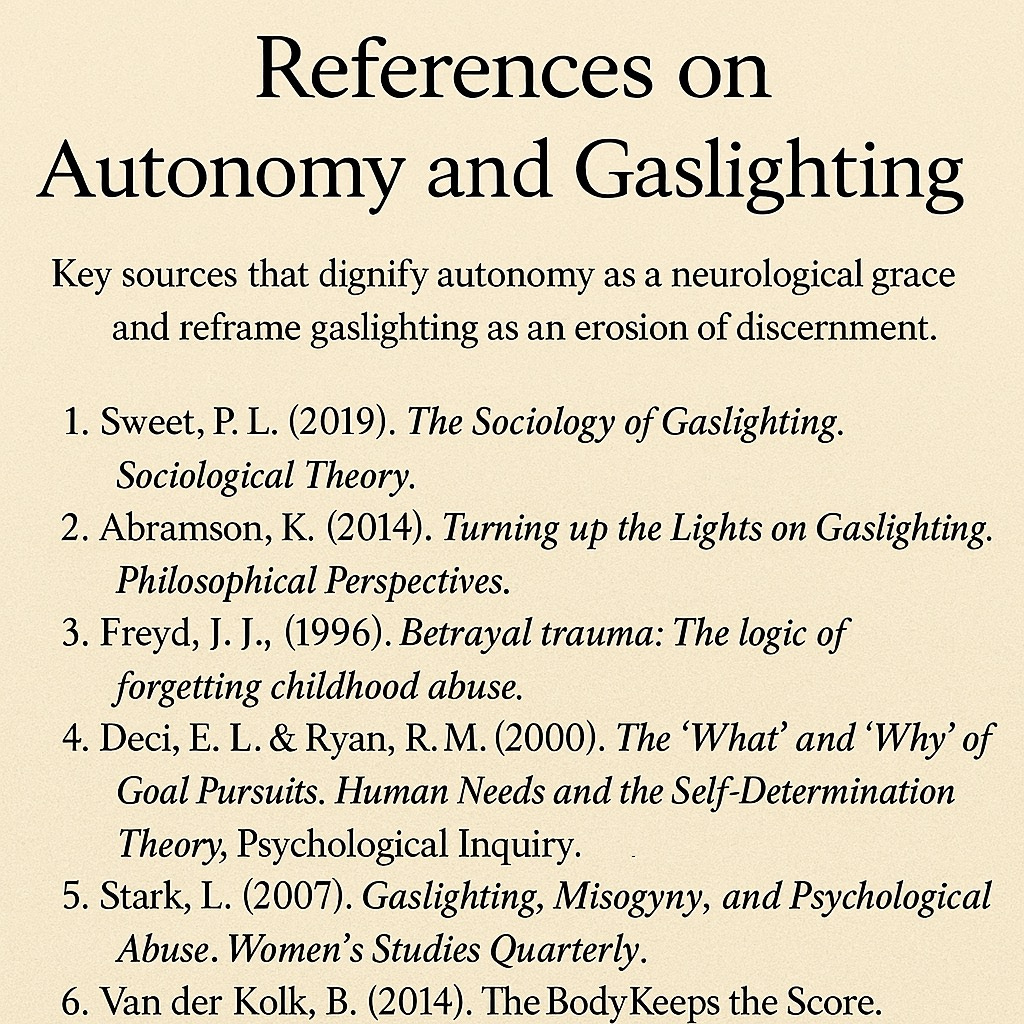
Historical Background
There is no established numerical “rate” of gaslighting before autonomy is lost, but research shows that autonomy erodes gradually through repeated psychological manipulation, often before the victim recognizes it.
While there is no quantifiable threshold—such as “X instances of gaslighting lead to loss of autonomy”— studies and clinical observations reveal a consistent pattern:
How Gaslighting Undermines Autonomy
Gaslighting begins with subtle distortions:
The perpetrator may reframe events, deny facts, or question the victim’s memory. This creates epistemic insecurity—a loss of trust in one’s own perception.
Autonomy erodes before full awareness:
Victims often begin to doubt their decisions, defer to the manipulator’s version of reality, and lose confidence in their ability to act independently.
Neurological impact:
Chronic gaslighting activates stress responses, leading to anxiety, hypervigilance, and cognitive confusion. These effects compromise executive function and decision-making, further weakening autonomy.
Complex trauma accelerates erosion:
Individuals with prior trauma are more vulnerable, as gaslighting exploits pre-existing self-doubt and emotional fragility.
What the Research Says
~ A 2023 study in Personal Relationships found that once survivors accepted “epistemic incompetence,” perpetrators gained control over behavior and accountability.
~ Theoretical frameworks emphasize that gaslighting is not a single event but a process—a slow erosion of reality that culminates in behavioral control.
~ Long-term effects include diminished self-trust, emotional dependence, and loss of agency.
-30-
Regarding the topic of the article, your insight into debuging our understanding of autonomy versus the often misapplied gaslighting term is so on point and crucial for clear communication, just like that brilliant piece you did on our digital emotional boundaries.