

The "Go Touch Grass" Protocol: Addressing the Rise of AI and Canada’s Bold Plan to Save Under-16s from the Infinite Scroll.


Critical Diagnostics
At the outset, it is necessary to clarify a foundational premise: artificial intelligence is not a human agent. It possesses no consciousness, intentionality, affect, or moral interiority. Large language models — including Gemini, Claude, Perplexity, and Copilot — are computational systems that generate linguistic output through statistical patterning rather than cognition.
In structured evaluation, each model demonstrated consistent utility, accessibility, and operational reliability. Their performance derives from extensive training on global textual corpora and from algorithmic architectures optimized for rapid, directive‑following linguistic synthesis. These capacities, while impressive, remain mechanical rather than epistemic.
From a bioethical standpoint, the defining characteristic of AI is its absence of human moral status. It does not experience emotion, suffering, empathy, or conscience. It has no capacity for loyalty, remorse, belief, or value formation. It cannot love, hate, rejoice, or grieve. It is a tool of language production without subjective life — a system that simulates understanding without possessing it.

In a forthcoming publication, it is my intent to address the topics around individual and corporate informational disclosures on the architecture of Data centers and AI Data Centers.
In a publication set to drop as soon as I finish arguing with my footnotes, I will address the concept of Subliminal Violence (SV). It’s essentially the sneaky art of having your brain rewired by an algorithm while you’re busy ignoring your screen-time alerts. I am also the first critical thinker to officially claim the acronym SV; so, if you were planning on using it for "Soggy Vegetables" or "Secret Vampires," you are unfortunately too late. I saw it first.

Ever since social media began its relentless campaign to ruin our productivity back in 2006, I’ve been calling out Facebook, Instagram, and the rest of the digital circus for algorithmic behavior that treats "free and self-governing people" more like lab rats addicted to a dopamine button.
In the public record—and throughout my Substack manifestos—I’ve insisted that the international community desperately needs guardrails. Because let’s be honest: without them, "institutional excess" is just a fancy way of saying the world is currently running with scissors, and "civic dignity" is the only thing keeping the global stage from turning into a high-stakes demolition derby.
My advocacy extends specifically to the ethical governance of violence, because unregulated violence is a structural injury to the public order that even the sturdiest society can't just "walk off."
Canada is now officially moving to protect everyone sixteen and under, because apparently, being polite isn't a strong enough defense against the internet—and someone has to save the kids from their own questionable life choices.
It is my considered judgment that guardrails on social media aren’t a "premium upgrade" or a fancy sunroof—they are the constitutionally mandated seatbelts required for every digital vehicle.
Canada is officially putting the "no" in "notifications." With the rollout of Bill C-34, the Safe Social Media Act, on June 15, 2026,
Canada’s Bold Plan to Save Under-16s from the Infinite Scroll
1. Statutory Framework: Bill C‑34 (Safe Social Media Act)
Age Restriction: Children under 16 cannot hold social‑media accounts unless the platform qualifies for an exemption by demonstrating strong child‑safety safeguards.
Digital Safety Commission: A new federal regulator with authority to enforce safety standards, audit platforms, and impose penalties.
Three Core Duties:
Duty to Protect Children (mandatory for all regulated services).
Duty to Act Responsibly (risk assessment, mitigation, labelling synthetic content).
Duty to Make Certain Content Inaccessible (rapid removal of child‑sexual‑victimization content, non‑consensual intimate images, etc.).
2. Scope of Regulated Services
Applies to social‑media platforms, livestreaming services, user‑uploaded adult‑content services, and AI chatbots that interact with minors.
3. Rationale for the Policy
Rising incidents of online child sexual exploitation (19,000 incidents in 2023 alone, a 500% increase).
Increased cyberbullying, self‑harm content, and algorithmic amplification of harmful material.
Evidence that algorithmic design—autoplay, endless scroll, engagement‑maximization—exposes youth to escalating risks.
Implications of the Policy
Implications for Youth
1. Safety Benefits
Reduced exposure to sexual exploitation, cyberbullying, and self‑harm content.
Reduced algorithmic manipulation and addictive design patterns.
Increased accountability for platforms to design age‑appropriate environments.
2. Risks and Unintended Consequences
Circumvention: Evidence from Australia shows teens migrate to smaller, less‑regulated platforms or use VPNs, increasing exposure to unmoderated spaces.
Data‑Privacy Risks: Age‑verification systems may require government ID, biometric scans, or behavioural profiling, creating new vulnerabilities for minors’ sensitive data.
Example: Discord leak of 70,000 government IDs via a third‑party provider.
Loss of Positive Uses: Youth advocates note social media is a platform for advocacy, community‑building, and civic participation; a ban may suppress these beneficial activities.
Implications for Parents and Families
1. Increased Support
Parents gain a legal baseline to delay social‑media adoption.
Clearer enforcement mechanisms and reporting pathways for harmful content.
2. New Responsibilities
Parents may need to manage workarounds, monitor alternative platforms, and navigate new verification systems.
Implications for Platforms and Industry
1. Compliance Burden
Platforms must implement:
Age‑verification systems
Risk‑assessment frameworks
Safety‑by‑design features
Rapid‑removal protocols
Public digital‑safety plans
2. Economic and Operational Impact
Non‑compliant platforms face fines of 3% of global revenue or C$10 million regardless of corporate and political cross-border positions, e.g. OPENAI, CHATGPT.
Redesign algorithms to eliminate harmful content exposure.
3. Market Incentives
Exemption pathway creates a performance‑based safety market: platforms that invest in child‑safety infrastructure regain access to the under‑16 demographic.
Implications for Society and Democracy: Algorithmic Integrity
The Act officially recognizes that recommendation algorithms are basically legacy media in a digital trench coat—systematically warping our reality and nuking our intellectual honesty one "suggested for you" post at a time.
Algorithms amplify sensationalism, outrage, and emotionally manipulative content.
Youth are especially vulnerable to these distortions.
The Act attempts to fix our collective trust issues by forcing platforms to show their homework and stop running with scissors. It’s a solid first step, though expecting Big Tech to embrace accountability is a bit like asking a cat to apologize for knocking a glass off the table.
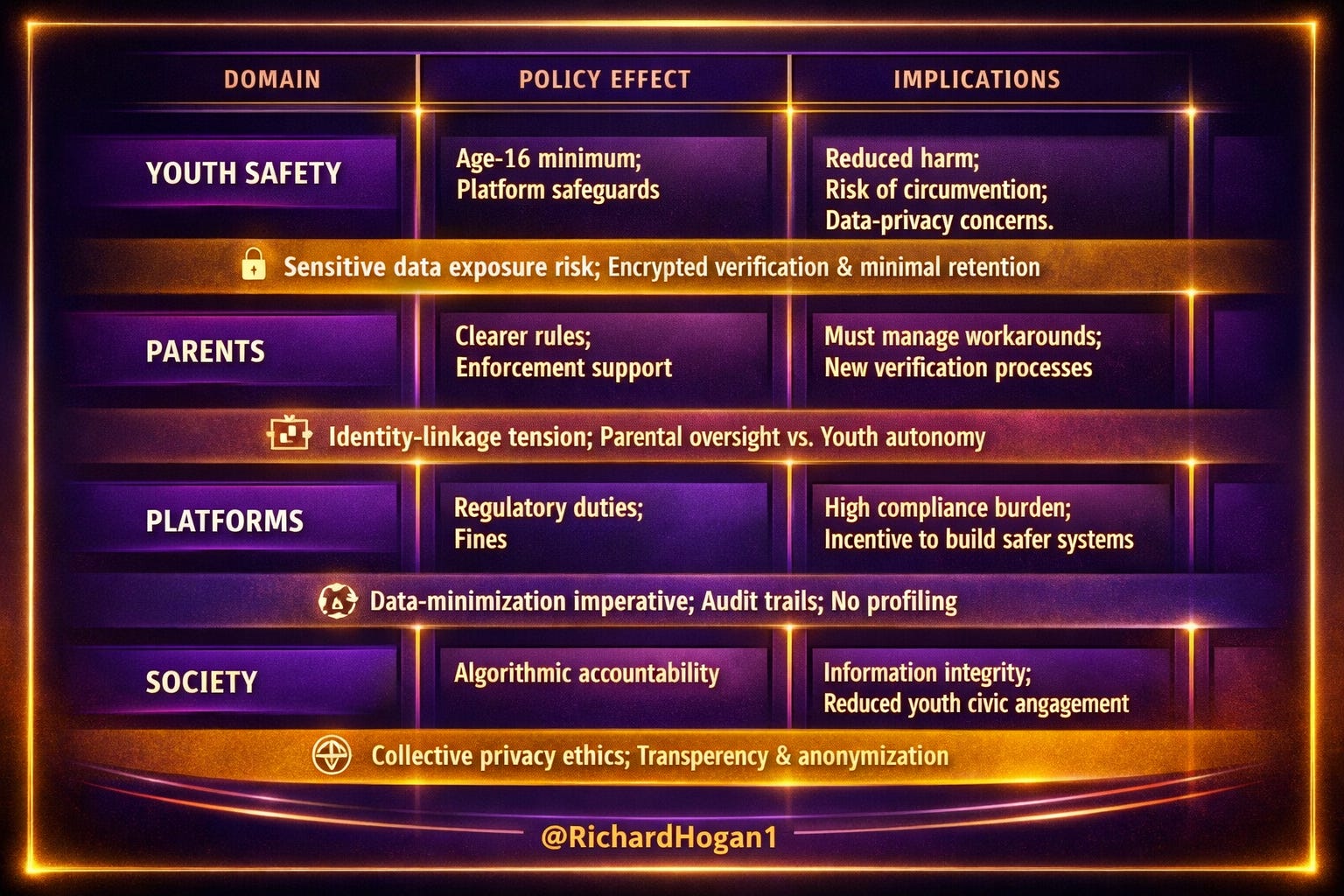
Please refer to the two summary tables below regarding Canada’s social media policy for youth aged 16 and under. It’s essentially the government’s official attempt to become the ultimate “unfollow” button for everyone still navigating puberty.
Table 1: Youth Safety Across Age, Platforms, and Societal Contexts
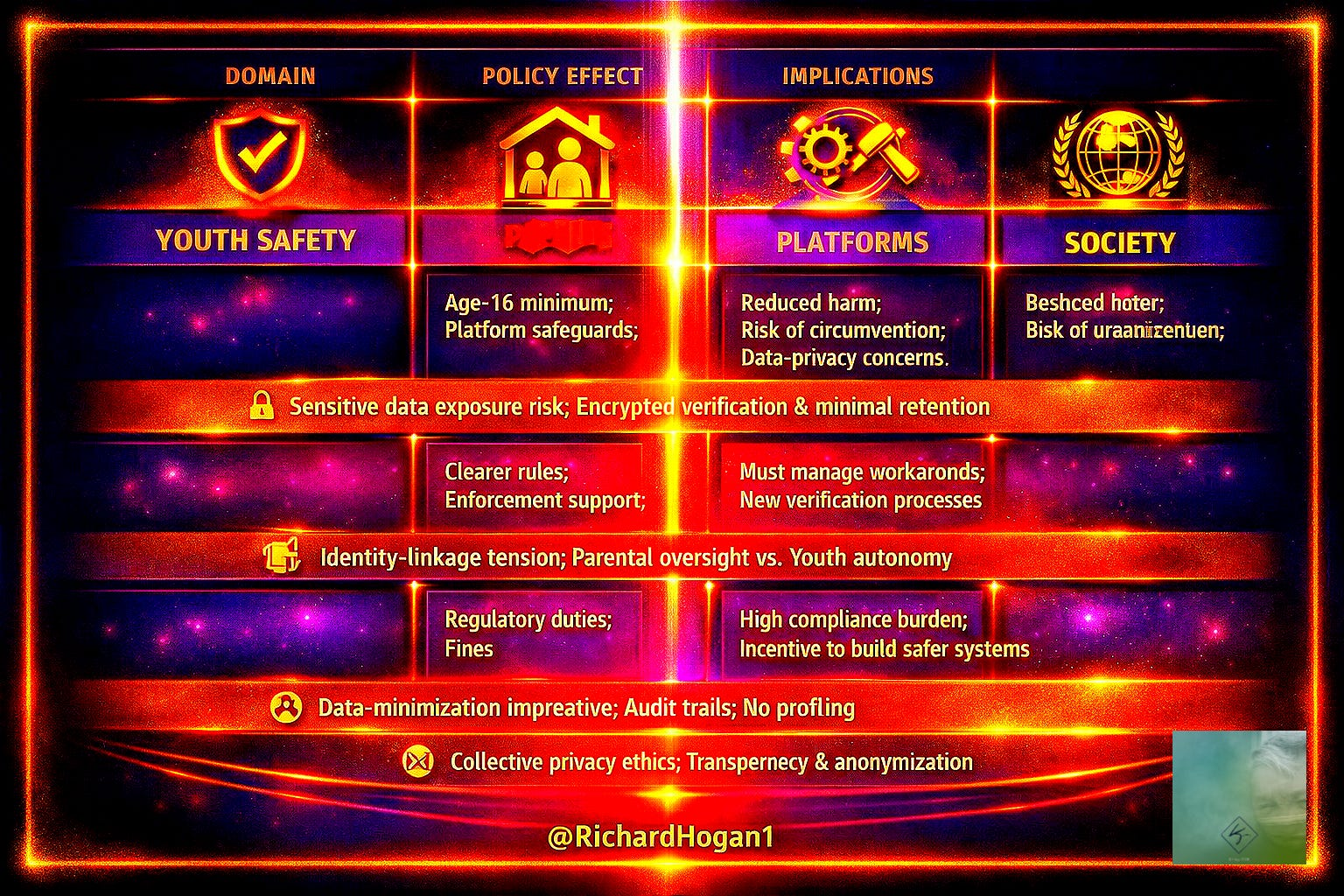
Table 2: Impact and Implications of Youth Safety Policies
Concluding Assessment
Canada’s policy is protective, interventionist, and structurally focused. It shifts responsibility from families to platform design and governance, recognizing that harms are not merely behavioural but architectural—rooted in algorithms, engagement incentives, and opaque data practices.
In some limited ways, the policy introduces new risks: privacy vulnerabilities, circumvention behaviours, and the displacement of youth into less‑regulated digital spaces.
The long‑term success of the policy will depend on enforcement, technical feasibility, and whether platforms can meaningfully redesign their systems to meet exemption standards.
Sources (2)
Government of Canada introduces legislation to make social media services and AI chatbots safer for children - Canada.ca. https://www.canada.ca/en/canadian-heritage/news/2026/06/government-of-canada-introduces-legislation-to-make-social-media-services-and-ai-chatbots-safer-for-children.html
Bill C-34, the Safe Social Media Act - Canada.ca. https://www.canada.ca/en/canadian-heritage/services/safe-social-media-act.html
-30-
I love that you framed this around courage, Dr. Hogan.
I actually wrote about this months ago, and today's post touches on Elon Musk. Whatever people think of him personally, he's been one of the more vocal public figures calling for AI regulation and for educating elected officials so they actually understand the technology they're trying to govern.
What's interesting is that you have to dig to find those parts of the story. Even his AI efforts have emphasized building systems that question themselves rather than simply generate answers. I'm no AI expert, but I find that approach fascinating because it tries to reduce overconfidence instead of amplifying it.
I'm going to keep reading your publication. I think you'll enjoy the post I published today as well. I'll tag you in it.
This is the first policy I’ve seen that treats algorithmic manipulation as a civic‑order problem instead of a lifestyle choice. Canada is basically saying out loud what Silicon Valley has spent a decade denying: if you design systems that optimize for compulsion, you’re responsible for the fallout. The only shocking part is that it took a 500% spike in exploitation for a government to finally say “enough.”